Saturday, September 22, 2012

33% Whole Wheat Artisan Bread (Revamped)

Hello loyal follower(s),

We have now been back at St George, UT for ten days and have been gradually returning to our normal routines.  Which means it is time to make some bread
My choice was the recipe from May 17, 2011 which was revised July 9, 2011.  One glaring error still remained which called for baking the bread for 50 minutes, which I hope was just a typo.  Anyway, there are changes that need to be made, that reflect what I have learned in the last year and half.
    First of  all, when rereading the book; My Bread by Jim Lahey, it finally came  through that he did very little deflating of the dough, thus leaving many air pockets in the dough which would translate into large irregular bubbles in the bread.
    Secondly, the concept of delayed fermentation is a neat idea but impracticable because it takes hours for the dough to warm up after refrigeration before you start the 18 hour fermentation. I decided to skip that step this time.
    Thirdly making two loaves at a time creates a problem when the dough is  split into two loaves.  I tried to separate the dough immediately after the 18 hour fermentation, and then form round without deflating the dough.

This was one of the loaves ready for a second fermentation without deflating the dough before forming a round.


This was the second loaf, notice the open spot which I think was from some of the air bubbles in the non-deflated dough.


After the almost two hours of the second fermentation, the loaves were placed into the hot Dutch ovens and then placed into the 450℉ oven for thirty minutes.


After thirty minutes the loaves were removed and placed on a piece of aluminum foil and baked  for another 20-25 minutes our until the internal temperature was 200-205℉.  Notice the foil on top of the loaves? It keeps the top from becoming too dark, use your judgement.


Voilà! the finish loaves.  Some people would prefer a darker crust than shown here.  I like the light crust.


Just look at that great crumb.  That was what I was seeking all along for the past two years.

But  by deflating the dough I was removing the bubbles I was seeking.


Why am I making bread again after declaring myself gluten intolerant in July  2012?  Because my intolerance of gluten was greatly exaggerated, I seem to handle gluten OK now.


Revamped recipe follows:

À bientôt, Mr Nut

33% Whole Wheat  Artisan Bread 
Revised Sept 22, 2012
Yield two seven inch rounds each about 1 1/2 pounds

European style: (Crisp-crust; large air spaces)

Inspired by Jim Lahey’s My Bread and
Cook's Illustrated website (Published September 1, 2003 )

Modified for a Cuisinart stand mixer, with speeds from 1 to 12

        Finally, Mr Nut found (in Canada) the perfect sized cast iron Dutch ovens. They are 3.3L

 or 3.48 quarts.  The most important measurement was the inside bottom diameter, which

 was 6.75 inches. The inside top diameter was 8 inches and the depth was 4.5 inches.
       This recipe provides freedom of choice with timing and techniques.  It is possible to start

 this bread anytime of the day and modify or delay the fermentation time to meet your

 schedule
.  
    Bread flour is wheat flour minus the germ the bran leaving only the endosperm. The

 endosperm contains the two proteins needed for making gluten. Vital Wheat Gluten needs

 to be added to help compensate for the smaller amount of gluten-forming proteins in the

whole wheat flour.

     Optionally, delayed fermentation can be used (3 to 10 hours) which  will soften the bran

 in the whole wheat and decreases the tearing of the gluten sheets. 

Long fermentation at room temperature eliminates kneading and allows for the yeast to

 work its magic.
  
The following (optional) natural healthful ingredients are added to improve bread volume or

 taste
Sea Salt, which contains additional minerals for better gluten development.

Dough Enhancer: self explanatory (see blog from April 5, 2011).
Wheat Gluten:It helps improve the rise and texture of the bread.

Fresh Rosemary: A natural antioxidant, acts as a preservative and flavorer.
     

Ingredients:
2 cups whole wheat flour ( 10 ounces, 280g)
1/4 cup vital wheat gluten (1.25 ounces, 35g)
4 cups (20 oz, 560 g) flour bread flour
1 tablespoon Sea Salt
1/4 cup Dough Enhancer
1 teaspoon instant dry yeast
2 teaspoons chopped fresh rosemary
about 2 1/2 cups cool 55-65℉ water (20 fl ounces)

  1. Mixing: In the mixer bowl using the Chef’s Whisk at speed one, mix the blue ingredients.  Change to the Flat Paddle Blade on speed 1 and just enough cool water  to yield a firm but workable dough.  Keep mixing to a minimum. 
  2.  I usually omit this: Delayed fermentation: Move the dough to another bowl.   Spray the top of the dough with oil, and cover the bowl with plastic wrap. Refrigerate  the dough for 3 to 10 hours. Make the time fit your time schedule. Caution:  After the delayed fermentation you may want to place the dough on  a heating pad and allow it to return to room temperature before beginning the fermentation process.
  3. First fermentation is at room temperature (equal or greater than 72℉) for 12 to 18 hours. Again, make the time fit your time schedule, even 12 hours is workable.
  1. Create the two loaves:  Gently remove the dough (in one piece) from the bowl on to a floured working surface. Cut the dough into two pieces and form  rounds. 
  1. Second Fermentation: Set out two 15-inch square of baking parchment paper.   Generously dust them with flour.  Place the rounds into the center of the parchment papers.  Generously dust the rounds with more flour.  Tent the bowl with nonstick spray-coated foil, or a large bowl.  Let it ferment for 1 1/2 to 2 hours.   
  1. Preparing the oven: About thirty minutes before the end of the second fermentation, place the “Dutch oven” type pots in the oven on the rack just below the midpoint of the height of the oven and preheat the oven to 450℉ (takes about 20 minutes).  If you have a pizza stone, place it on the lowest oven rack ( makes a heat sink).  This recipe is based on cast Iron pots with  base diameter of 6.75 inches, which will yield two pound and half loaves. 
  1. Baking: Treat the parchment paper as a sling and carefully lower the dough with the parchment paper under the dough, into the HOT Dutch ovens. Bake on the middle rack for 30 minutes. Remove the Dutch oven lids.  Lift the loaves from the pots using the parchment paper as a sling, and remove the parchment paper and place the loaves on the middle oven shelf on a piece of aluminum foil.  (If the top is well browned, cover it with foil.).  Bake until the crust is a rich chestnut color, and the internal temperature of the loaf is about 200- 205℉. (about 25 to 35 minutes longer).   Note: the appearance of the loaf is more important in determining the doneness of the loaf than the internal temperature (from Cook's illustrated magazine, May-June 2011 page 31).
  1. Remove the loaf from the oven and place them on a rack to cool thoroughly. Don't slice the bread until it has cooled, which usually takes at least an hour. 

Thursday, September 20, 2012

Broccoli Salad


Broccoli Salad

Hello loyal follower(s)

I have never made Broccoli Salad before.  As you know I am a new comer to cooking except for bread making.   Through Cook’s Illustrated and Cook’s Country magazines I have learned  many good methods and used many of their recipes (modified of course).
    Yesterday I was intrigued with a Broccoli Salad recipe developed by Carolynn Purpura Mackay in the August/September issue of Cook’s Country.  What I like about Cook’s magazines is that they explain how and why the choose the ingredients.  They do the trial and error for you which does save time.  In a week from tomorrow I want to make Broccoli Salad along with, maybe Salt-and -Vinegar potatoes and marinated Grilled London Broil for dinner guests.  I’ll try the  Salt-and -Vinegar potatoes early next week to see of they will be included in the menu for our guests.

Back to the Broccoli Salad, I made what was supposed to be a recipe for two but with our appetites it was enough for four.  The result was that Cyndy did not like the vinegar taste and I felt it left an after taste of vinegar even after the meal was finished.  I asked to see Cyndy’s recipe that she uses (from her sister Donna Richter in Florida).  It was almost the same as the recipe I used,  except her’s did not have vinegar and used sugar instead. The broccoli stems were shredded on the food processor which I thought was an improvement over just cutting them into small 1/4 inch “wheels.”  Also sunflower seed were used instead of dealing with walnuts and there was no onion.

By taking the best of both recipes I present to you a great recipe for Broccoli Salad.

Recipe follows:

À bientôt,

Mr Nut

Broccoli Salad
Based upon recipe from Donna Richter
Serves 4 senior citizens

Ingredients:
2 slices bacon chopped fine
1/4 cup raisons ( I like golden raisons)
two broccoli crowns: 2 cups broccoli florets,  cut into about 1/2 inch pieces, stems peeled and shredded (use small hole blade) in the food processor.
1/3 cup mayonnaise
1 teaspoons Natural Cane Turbinado sugar (This is a new to me but Cyndy uses it and has it on hand)
1/2 teaspoon salt
1/4 teaspoon black pepper
2 tablespoons sunflower seeds

Instructions:

  1. Process the broccoli; keep the florets separate from the stems. Put water into the food steamer and heat the water to steam.
  2. In the microwave, heat 1/2 cup water to boil,  in a small glass bowl and then add the 1/4 cup raisin and let then soak for  five minutes.
  3. While the water is heating in the steamer, chop the two bacon strips into small pieces and cook them in the skillet. Set the cooked bacon aside on a paper towel.
  4. When the steamer is ready place the broccoli florets into the steamer for one minute, then lay them out on a clean paper towel to dry.
  5. Shred the broccoli stems in the food processor (use fine blade).
  6. In a large bowl, whisk together the 1/3 cup mayonnaise, 1 teaspoon sugar, 1/2 teaspoon salt and 1/4 teaspoon black pepper.
  7. When dry add the broccoli florets, stems, raisons and sunflower seeds to the bowl with the mayonnaise mixture. Toss to combine  and season to taste.  If the bacon bites have cooled enough crush them into very small pieces and sprinkle on top of the salad.

This salad can me made up to six hours in advance of serving.

Tuesday, September 18, 2012

Spanish Rice with Pork Chops

Spanish Rice with Pork Chops

Hello loyal follower(s)

The misadventures continued (not on purpose) as I attempted to make dinner with a fool proof recipe.   In the  May 7, 2011 I first presented the recipe for Spanish Rice with Gas-Grilled Pork Chops.  Cyndy had been out most  of the day running errands and dinner needed to be made and the above recipe it looked  so easy that nothing could go wrong.  Thus I  decided to do it again.  I actually had all the ingredients and lots of confidence.

Based upon my "vast" experience with brining I cut down on the salt and sugar called for in the original recipe. and modified the directions for grilling the pork chops.


The pork chops had just finished  "browning"two minutes on the down side, and were just starting the two minute browning process on the other side.

Then they were placed just off the heated part of the grill and covered until the internal temperature reached 135℉.


Meanwhile the sauce that was to be poured over the uncooked brown rice was prepared.  The oven was heated to 375℉ ( I forgot to write that information into the original recipe). The sauce was poured over the rice and baked in the oven for 45 minutes,


After baking for 45 minutes this was what it looked like ----NOT GOOD.  Too dry and the rice was not cooked enough.  And that's where the title of this blog comes from.
Rechecking the recipe I found that it called for two cans of tomatoes not just one.

I finished the pork chops, added them to the rice dish, added the second can of tomatoes and baked the mess for fifteen more minutes.


Meanwhile I turned my attention to The vegetable for dinner.  It is hard to screw up steaming carrots, you may cut yourself and if you don't pay attention you could over cook them.

They came out perfect.


The end result - not pretty but not bad tasting

You cannot see it but I added shredded  Cheddar cheese before the second can of tomatoes.  It was suppose go on the top of the finished product, but hey! it was in there somewhere.

Cyndy came home while I was in the middle of this creation and immediately fell asleep in her queens chair (located about 20 ft from my work station).  It didn't phase her, when I almost dropped the whole mess on the floor when I burned my hand through a too thin hot pad.

Anyway we now have an extra meal done for Wednesday evening.

Revised recipe from May 7, 2011 follows:

À bientôt,
Mr Nut


SPANISH RICE WITH GAS-GRILLED PORK CHOPS
Spanish rice based on Better Homes  & garden 75th year edition 2005
Pork chops based on Cook’s  Illustrated website Published May 1, 2002
Serves 4 

Brining the chops to pump up their flavor and lock in their moisture; is the  secret to the juiciest, most flavorful pork chops.    
      
Brining Ingredients:

      1/4 cup  Sea salt or table salt
      1/4 cup granulated sugar
      4 loin pork chops or center-cut loin chops, each 3/4 inches thick

Pork Chop Instructions:
  1. Dissolve 1/4 cup salt and 1/4 cup sugar in about 20 ounces cold water in 1-gallon zipper-lock plastic bag (or a flat glass container). Add chops and seal bag, pressing out as much air as possible. Refrigerate, turning bag once, until fully seasoned, about 30 minutes. Remove chops from brine and dry thoroughly with paper towels. 
  2. Light grill and turn all burners to high; cover and heat grill about 5 minutes. Use wire brush to scrape cooking grate clean then oil the grates. Turn off all but one burner. Place chops over hotter part of grill, cover, and cook until browned on each side, 1 to 2 minutes per side. Move chops to cooler side of grill. Cover and continue cooking, turning once, until instant-read thermometer inserted through side of chop  registers 135 degrees, 1 to 2 minutes longer. Transfer chops to casserole of cooked rice and sauce. . 
Spanish Rice ingredients:
      1/2 cup chopped onion (1 medium)
       I/2 cup chopped green sweet pepper
      1 teaspoon clove minced garlic
      1 tablespoon olive oil
      1 teaspoon chili powder
      2 cans of 14.5 ounces can diced tomatoes, undrained 
      1 cup water
      1/8 teaspoon Sea salt
      1/8 teaspoon black pepper
      Several dashes bottled hot pepper sauce (Tabasco)
     1  cup uncooked brown rice
     1/2 cup shredded Cheddar cheese 

Preheat oven to 375℉
  1. In a large skillet with 1 tablespoon hot olive oil,cook 1/2 cup onions, 1/2 cup sweet pepper, and 1 teaspoon minced garlic tender ( about one minute). Add teaspoon chili powder; cook 30 seconds more. Stir in TWO cans diced tomatoes undrained, hot pepper sauce, 1 cup water, 1/8 teaspoon salt, and 1/8 teaspoon black pepper. Bring to boil. 
  2. In a Casserole about 12 inches square and at least 2 inches deep, place the uncooked rice in the bottom and pour the results of step one over the rice and stir. Cover the casserole and bake  in the preheated oven for 45 minutes.  Embed the grilled pork chops  in the rice sauce mixture and sprinkle with the 1/2 cup shredded Cheddar cheese. Bake for another 15 minutes.


Sunday, September 16, 2012

Oklahoma Fried Onion Burgers


Oklahoma Fried Onion Burgers
Inspired by the Cook's Country magazine; Aug-Sept article and recipe by Diane Unger 
Modified for Misadventures of Mr Nut

This burger was developed during the late 1920‘s out of Depression era need for a cheaper burger.  It was developed in a small Hamburger Inn about forty-five minutes east of Oklahoma City.  There, a burger isn’t a burger without a mound of thinly sliced onion pressed into a thin, crispy patty as it sizzles on the fast-food griddle. To make them at home, Diane Unger sliced and salted the onions, then squeezed the moisture out of them so they’d easily stick onto the burger. Starting the burger over a moderate heat enabled the exterior of the onions to brown while the interior softened. Add a slice of American cheese and these burgers will taste like they’re straight from the griddle.  Diane Unger described her difficulties, as she perfected the following recipe.


 A mandoline makes quick work of slicing the onion thinly.  This was a new word for me, and a picture of one is at the left in the picture.  Just look at the size of the mound of onions.  About 3 cups lightly packed.


 After the salt has been added to the onions they were placed in a colander for thirty minutes so the juice could drain out.  Then they were wrapped in a clean dish towel (I used paper towels, but the dish towel would have  been better) and squeezed as much juice out as possible so they well adhere to the patties.


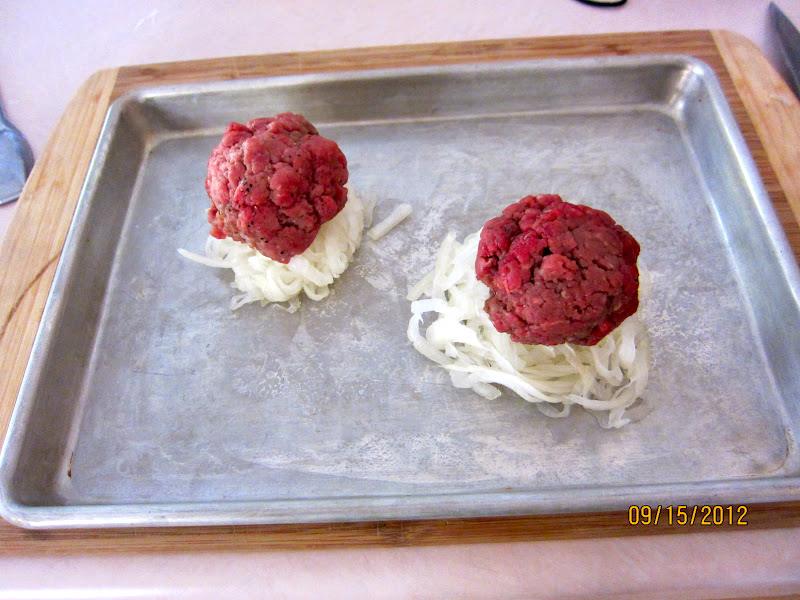
Using a rimmed baking sheet place the onions in two mounds.


Place the loosely packed hamburger balls on the globs of onions. 


The hamburger balls are smashed down into the onions, so they are very thin burgers.


 Here’s the finished product. As you can see I used thin buns, but I think regular whole wheat bun would have been better.These burgers are traditionally served with yellow mustard and slices of dill pickle. But my dear wife doesn’t like either---her loss.
INGREDIENTS

1/2 of large onion sliced 1/8 inch thick about three loosely packed cups
1/2 teaspoon Salt 
 Pepper to taste
8 ounces 85% or higher lean ground beef
1/2 tablespoon unsalted butter 
1/2 teaspoon Canola oil
2 slices American Cheese
2  buns buttered and toasted


INSTRUCTIONS WITHOUT PICTURES
  1. Combine onions and 1/2 teaspoon salt in bowl and toss to combine. Transfer to a colander and let sit for 30 minutes, tossing occasionally. Using tongs, transfer onion to clean dish towel, gather edges, and squeeze onion dry. Sprinkle with 1/4 teaspoon pepper.
  2. Divide onion mixture into 2 separate mounds on rimmed baking sheet. Form beef into 2 lightly packed balls and season with salt and pepper. Place beef balls on top of onion mounds and flatten beef firmly so onion adheres and patties measure ABOUT 5 inches in diameter.
  3.  Melt butter with oil in 12-inch or larger nonstick skillet over medium heat. Using spatula, transfer patties to skillet, onion side down, and cook until onion is deep golden brown and beginning to crisp around edges, 6 to 8 minutes. Flip burgers, increase heat to high, and cook until well browned on second side, about 2 minutes. Place 1 slice cheese on each toasted bottom bun. Place burgers on bun, add desired toppings, and serve.
This was a winner for me, and I do not think errors were made making this great burger.  It sort of reminded me of White Castle “sliders” only with much more meat per burger.  If you are real good you could make this in about 45 minutes start to finish.
Right now I am sitting in a hotel room at the CasaBlanca casino in Mesquite Nevada while my lovely spouse is entertaining herself at the slot machines. The hotel charges $5.99 for one hour of internet use. I guess I can understand this because there are nine floor each with 63 rooms.  Free Wfi could overwhelm the network.  We got the room free so I can’t complain too much.  Therefore I moved to McDonald's to post this blog.
Anyway it is good to be back writing this blog, even though the direction the blog will take is not clear.  probable more entries than bread.

À bientôt. Mr Nut

Saturday, September 15, 2012

August 13 to September 13 Odds and Ends

August 13 to September 13 Odds and Ends

Hello loyal friend(s)

Without  internet availability, writing a blog required a trip to the library in Brainerd, Minnesota.  But now I am back at home in Saint George, Utah, and  am raring to get back to my blog.
On August 16, we had Harry Ziegleman, an old high school friend of mine ( we were on the wrestling team together) over for dinner along with his "wife".   He lives on the East side of  Mille Lacs, (one of the larger lakes in Minnesota) about forty miles from our cabin. 

On August 17 our lake neighbor (year round resident ) hosted a dinner picnic for five families  near our cabin, It was great fun, with no mosquitoes.

August  27  Joanne and Dave Sufka were at our cabin for dinner.  They spend the summer in their Condo about ten miles from our cabin, and the winter months they live in their Condo in 
sun River just south of St George, Utah.

The week of August 20-24 The roofing contractor re-roofed our cabin.  While they were finishing up the job I discovered he was the man who took care of the Sufka's Condo during the winter, and was friends of Joanne and Dave----Small world--
After the roofing was done I planted grass seed on the dirt that was hauled onto our driveway. See the last blog which has pictures of a handsome  guy on  Bobcat.

Around Labor Day Cyndy and I took two bike hikes; one near Crosby- Ironton an another  from Nisswa to Pequot Lakes, each bike hike was approximately fifteen  miles long.


This was taken on our bike hike along the lakes formed by the Iron Mining Range. The lake in the background was one of the mining pits, and is 400 feet deep.


All summer long Cyndy worked on a quilt for me, and by the end of our stay at the cabin she had finished all thirty squares.
September 6 we said goodbye to our cabin and started for home.  We stopped to see our friends of 53 years in Kanas City.


Cyndy and our Kanas City friends Sharon and Lyle Bighley.  Mr Nut is the shadow taking the picture.


I just had to share this photo of four kids on the Futon at our cabin. look carefully there are four.


Now i am back at home and both Cyndy and I have finished digging out from all the accumulated mails and dealt with the financial stuff. 

Last night I made my pizza with some substitutions for missing ingredients.  That is why this blog is called Misadventures of Mr Nut.  This summer Cyndy purchased a 16 ounce package of regular Jimmy Dean sausage.   It only yielded a little over 7 ounces of cooked sausage. A 12 ounce Reduced Fat Jimmy Dean sausage is a much better buy.


Here is my creation for the pizza ready for the oven.  I used celery to add crunch to the pizza because we did not have any cauliflower.


Tonight I am going to make Oklahoma Fried Onion Burgers from Cook's Country Aug/Sept magazine, and of course I will be modifying the recipe.  Tomorrow's blog.

À bientôt,
Mr Nut

Monday, August 13, 2012

Band concert at Lake Harriet and four days in Rhinelander WI

Band concert at Lake Harriet and four days in Rhinelander WI
August 13, 2012
How to Navigate around in Mr Nut’s blogs:  At the left of the tool bar directly above the blog is an input box.  Type in as much of  the title as you remember and then click return.

Hello loyal follower(s),

I do not know where all the time has gone but it is now almost the midpoint of August and in about three weeks we will be heading back to St George, UT.
On the 25th of July we drove to Minneapolis ( about 130 miles) to attend a concert by the Hopkins West Wind Band at Lake Harriet.  This was Cyndy's old band which after twenty years still had many of the old friends as members.  There was a light rain during much of the concert but we had umbrellas and a great time.
The next day we had lunch with my high school friend Joanne Knabe and here current flame.  On Sunday July 30 we drove to Rhinelander, WI  (310 miles) for four enjoyable days with Cindy's cousin Sandy and her husband Denny Doubek.  There was a free museum on the lumbering industry which I enjoyed ( I do not usually enjoy museums) and would go back to with my computer glasses so I could read the material better.

I had fourteen yards of road base delivered to top coat our existing cabin driveway.  And of course I needed a tool to spread it out. Voilà a neat Bobcat.


Here I was playing while wearing ear protection.  There were tow foot levers. One controlled the bucket movement and the other controlled the raising and lowering of the bucket.  The Bobcat movement was controlled by had levers.  There was also a throttle  lever.


i was through with the dirt moving in two hours, but believe me it takes more than two hour to master the controls.  


Sometimes i wondered what happened to the bucket, where did it go?


Here are some neat pictures from when Michael and Stephanie were at the cabin during July.


Christine and Blake playing in the bay.


Christine and Blake casting for bass in the bay


Michael and his two kids Christine and Blake.
Note the new shelf cabinet in the  background, it was a morning project.


Michael, Cyndy and myself.

There are many nice pictures 


The whole gang; taken by Stephanie.


Anyway, here it is the thirteenth of August and we have only gone biking once.  i hope we can go on at least three more bikes rides.
There are still two more work projects that we should do before we leave for St George.  Also, the quilt that Cyndy has been working on has received little attention.  At least we have not been bored.

À bientôt,
Mr Nut